

Sole Searching

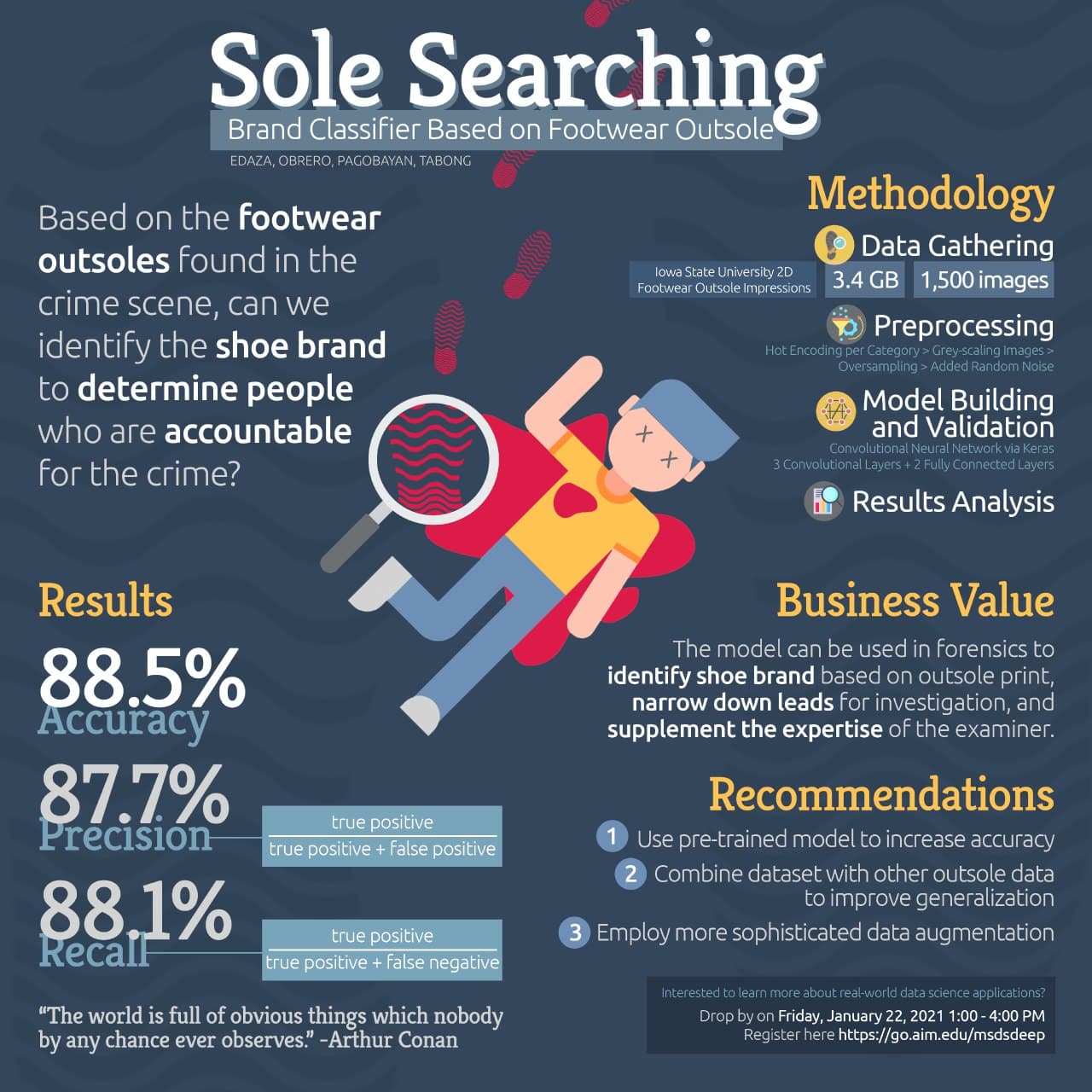
This is our final project for our Deep Learning class in collaboration with Elkan Pagobayan, Kris Tabong and Tonichi Edeza. Findings were shared in an online public presentation.
Summary
The use of articial intelligence and machine learning in law enforcement is nothing new. In realm of the judiciary, natural language process techniques have been used to predict the outcomes of judicial decisions[1]. However, the arti cial intelligence can also be used to augment policework. This can take the form of unmanned drones, tapping into data generated by the internet of things, and of course image processing and identi cation[2]. This paper shall focus on the last one as it applies to the identi cation of shoes based on shoe outsoles. It was found that the use of convolutional neural networks can successfully identify shoeprints with an accuracy of up to 97% [3]. In this paper however, we explore the concept of identifying the brand of a shoe based solely on its print.
Business Value
In countries like the Philippines, forensic science is still lags behind the modern world. It is a painstakingly manual process that involves extensive documentations and man hours to fully complete. For something like shoe print identi cation, a process which requires the identi er to have signi cant background knowledge on shoe brands and models, these issues are exacerbated. Using machine learning to help cut down this time tremendously can help narrow down leads for investigators. This helps remove at least one bottleneck in the investigative process. This will not only help cut down processing time for police work, but also help the department become more willing to work with data scientists. Additionally, it will help reduce any human error which may lead to both resource wastage as well as wrongful conviction. The development of a machine learning algorithm will therefore not just have a business value but a societal value as well.
[1] Medvedeva, M., Vols, M., Wieling, M.: Using machine learning to predict decisions of the european court of human rights. Artif Intell Law (2019) [2] Campbell, T.: Opportunities and challenges from arti cial intelligence for law enforcement (2018) [3] Li, C.: Shoe print identi cation from images with convolutional neural network (2018)